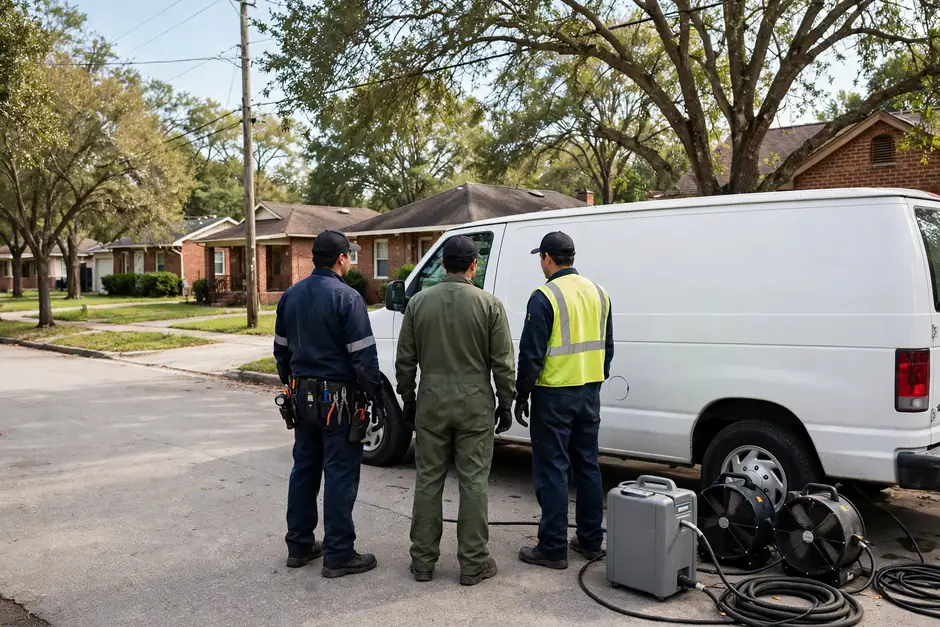
What to Check Before Hiring a Restoration Pro in Houston
After water damage, the company you hire matters as much as the work itself. The right company puts the scope in writing, documents the loss, and explains the rules that apply to your job. The wrong one starts work before you know what you are paying for. Here is the checklist to use before anyone starts.
After water damage, the company you hire matters as much as the work itself. The right company puts the scope in writing, documents the loss, and explains the rules that apply to your job. The wrong one starts work before you know what you are paying for. Here is the checklist to use before anyone starts.
Read verified reviews, not website testimonials
Start with the company's Google profile. Read the reviews that Google shows, and look for detail: what the job was, how the crew communicated, whether the scope was clear. A company with a real review history will have reviews that sound like real jobs, not slogans. Restoration Enterprise holds a 4.7-star rating from 152 Google reviews, and the reviews we publish are the real words of real customers, not copy we wrote ourselves.
Be cautious of a company whose website shows testimonials you cannot trace to a real profile, and be cautious of any company that asks you to post a review yourself. Reviews belong to the customer, posted from the customer's own account.
Ask for a written scope before work starts
Before anyone starts, ask for the scope in writing: what will be extracted, what will be dried, what will be removed, what will be cleaned, and how drying will be verified. Ask whether mitigation and repair are priced separately. Ask what happens if the crew finds more damage once a wall is open.
A written scope protects both sides. It is the document you compare with the invoice, and it is the document your adjuster works from. Our water damage restoration in Houston work starts with a written scope for exactly that reason. A company that will not put the scope in writing is a company to walk away from.
Ask how they handle the Texas mold rules
Ask the company how it handles mold, and listen for the Texas rule in the answer. In Texas, mold remediation of 25 contiguous square feet or more requires a TDLR-licensed remediator, and the company that assesses the mold cannot remediate the same job. IICRC S500/S520 are industry standards, not law. Mold assessment is a separate licensed activity from remediation, and mold inspection and testing are not the same as remediation.
A company that offers mold inspection and remediation as a single combined service from the same crew is describing something the Texas rules do not allow. A company that explains the separation, and names the separate assessor for the job, is describing the rules properly. Our mold remediation in Houston page explains how the two roles are kept separate.
Ask what insurance documentation they provide
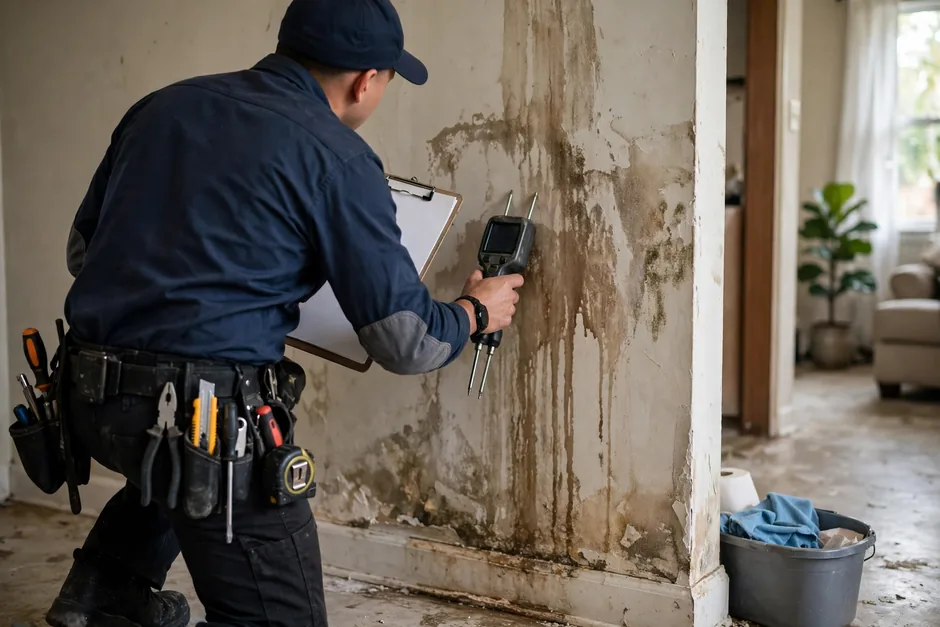
Ask what records the company will produce: photographs before anything is moved, moisture readings, an inventory of damaged items, and a written scope. Those records are what an adjuster needs, and a company that documents thoroughly is a company that has done this before.
As general information, a standard homeowners policy generally covers sudden and accidental water damage, generally excludes flood, and generally excludes gradual damage. No company can promise what a policy will pay, and no company should promise a claim outcome. Our water damage insurance claim assistance in Houston guidance is about documentation and communication with the adjuster, not about promises.
Check the basics: who does what, and who fixes the cause
Ask who does each part of the job, and who fixes the cause of the water. Plumbing repairs the pipe. Roofing repairs the roof. Foundation repair is a separate trade. Sewer-line repair is plumbing, not restoration. A restoration company that claims to do all of those trades itself is claiming more than a restoration company does.
Ask how the company can be reached, and whether it is open when you need it. Restoration Enterprise is open 24 hours, every day, and the phone is the way to reach us: (346) 980-0009. In Museum District and across the inner loop, the homes are older and the causes are varied, so knowing which trade fixes the cause matters as much as knowing who dries the damage.
Red flags to walk away from
Walk away from a company that demands an upfront payment for disaster remediation work, that will not put the scope in writing, that promises a price or a drying time before seeing the damage, or that offers to handle your insurance claim for you as if it were your adjuster. Texas law requires a written contract for disaster remediation work, and no upfront payment may be taken for disaster remediation work, with a narrow local-contractor exception.
Walk away, too, from door-knockers after a storm. A reputable company does not need to knock on doors after a flood. Call the company yourself, check the reviews, and get the scope in writing before any work starts.
Frequently Asked Questions
What should I check before hiring a restoration company in Houston?
Read verified Google reviews, ask for a written scope before work starts, ask how the company handles the Texas mold rules, ask what insurance documentation it provides, and confirm which trade fixes the cause of the water.
Should a restoration company put the scope in writing?
Yes. The written scope names what will be extracted, dried, removed, and cleaned, and how drying will be verified. It is the document you compare with the invoice and the document your adjuster works from.
What is the Texas mold rule I should ask about?
In Texas, mold remediation of 25 contiguous square feet or more requires a TDLR-licensed remediator, and the company that assesses the mold cannot remediate the same job. IICRC S500/S520 are industry standards, not law. Ask the company to explain how it handles that separation.
Can a restoration company promise my insurance claim will be paid?
No. No company can promise what a policy will pay or promise a claim outcome. A good company documents the loss thoroughly and communicates with the adjuster about scope. That is the limit of what it can promise.
Should I pay upfront for disaster remediation work?
Texas law requires a written contract for disaster remediation work, and no upfront payment may be taken for disaster remediation work, with a narrow local-contractor exception. Get the scope and the contract in writing before any work starts.
Choosing a restoration pro in Houston
Use the checklist, get the scope in writing, and call Restoration Enterprise at (346) 980-0009. We will explain the job, document the loss, and tell you plainly what we can and cannot do.
Sources
Sources for the rules and figures cited in this guide.
- Texas Department of Licensing and Regulation — Mold Remediation: Frequently Asked Questions — the Texas mold-remediation rules, including the 25-contiguous-square-feet threshold and the rule that the company that assesses the mold cannot remediate the same job.
- IICRC — Standards — the IICRC standards library, including S500 and S520.
- Texas Department of Insurance — Insurance Claim Deadlines — the deadlines that apply to Texas property insurance claims.